BXRT20–1Refrigerated trailer
- Nominal length
- 20ft
- Listed electrical supply
- 220V · single-phase · 40–60A
- Inventory temperature label
- 32°F
Vermont refrigerated container rentals provide temporary storage when a commercial walk-in cooler or freezer breaks down. Refrigeration trailers and portable cold storage also support planned kitchen renovations, with mobile kitchen and dishwashing trailers considered where other functions are affected. Restaurants, hotels, schools, hospitals and industrial food operations can discuss short-term rental or longer lease needs with Worldwide Refrigerated Container Rental Facilities. We serve businesses across Vermont, coordinating the proposed equipment and delivery around the property and project dates. Describe the stock, required conditions and available position to request availability and a current project quote.
Emergency cooler or freezer failure in Vermont? A person answers rental inquiries 24/7. Availability and delivery timing are confirmed in your quote.
Plan your rental budget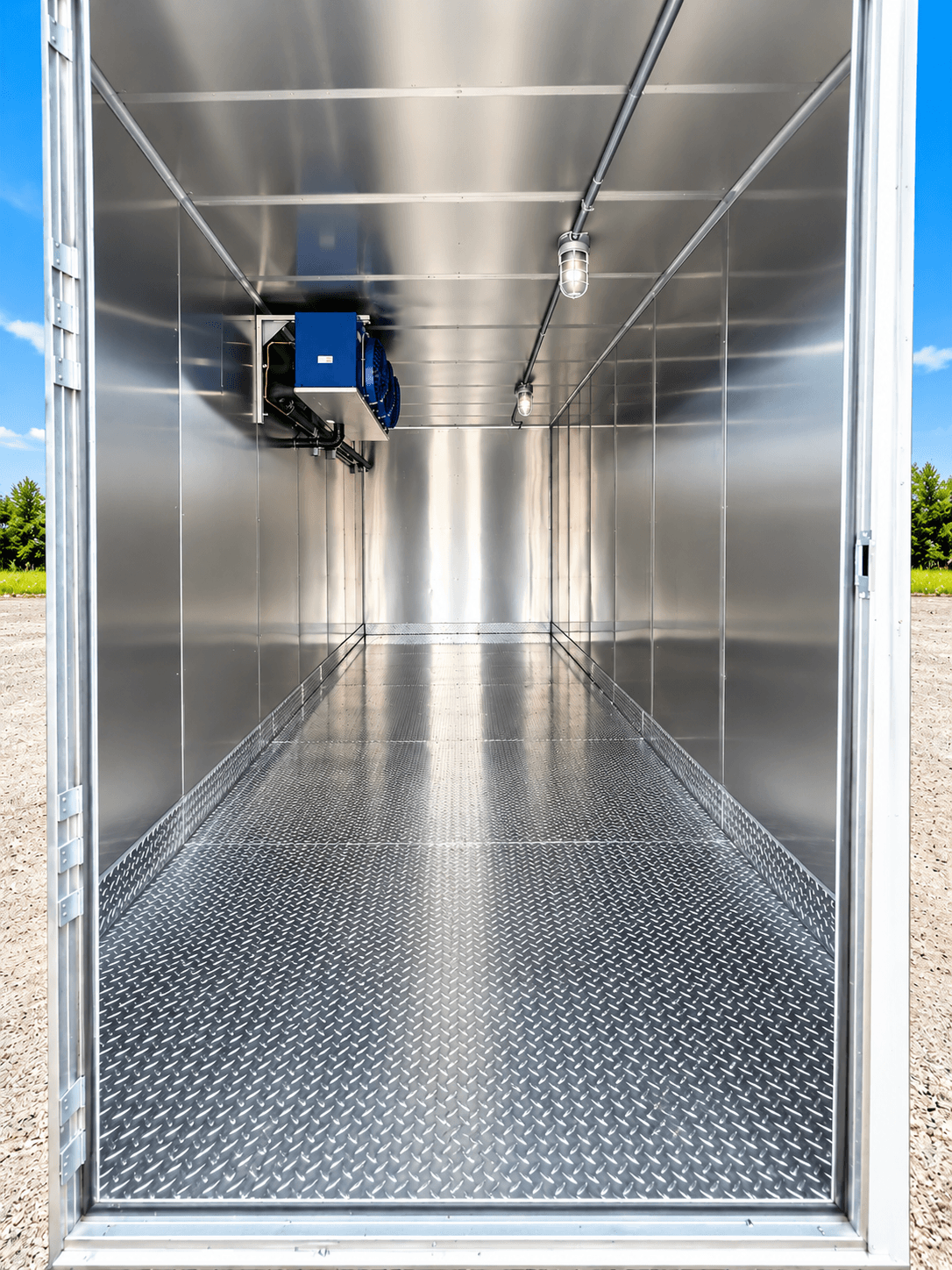
Compare the equipment
These published examples describe named company units. The supplied equipment, configuration and availability are confirmed for your project address.
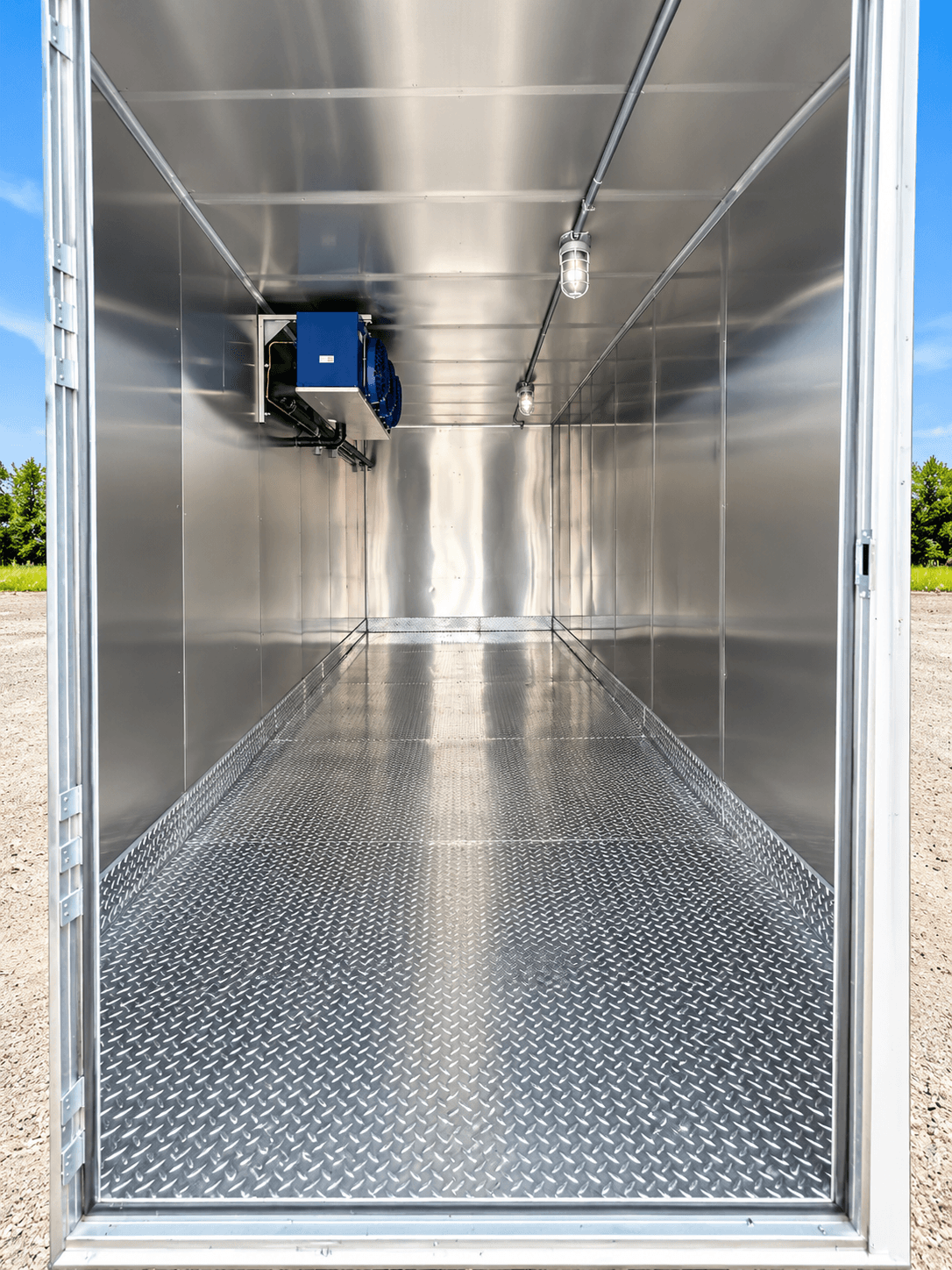
Listed refrigeration trailer equipment: condensing unit, amps panel, lighting.
Equipment records reviewed October 19, 2026. Temperature labels are inventory labels, not verified operating ranges. Nominal length is a model label, not a measure of usable space or site footprint.
A closer look at your project area
Choose a city to explore refrigeration rental planning for your area. Bring the delivery address, preferred dates and storage needs to your inquiry.
Outline: Census TIGERweb generalized states, ACS 2025. City locations: 2025 Census Gazetteer.
Find the place that fits your project
Emergency refrigeration rental in Vermont often starts with one decision: whether the stock belongs in an outdoor walk-in refrigeration unit for rent or in a different format, such as a rented walk-in freezer. The same equipment can be rented for a few days or leased for several months, depending on how long the permanent storage will be out of service. If cooking is also interrupted, a mobile kitchen trailer rental can sit beside the refrigeration, and a dishwashing trailer for rent can handle returned dishes.
Every call about a failed commercial walk-in freezer or refrigeration system is an emergency call, and a person answers rental inquiries 24/7 so the problem can be described at any hour. Short-term cover can be extended into a longer lease if the permanent unit takes longer to repair. A person answers rental inquiries 24/7, so an emergency in Vermont can be reported at any hour, including nights, weekends and holidays.
WCAX reported in September 2026 that 118,656 people attended the Champlain Valley Fair in Essex Junction, which NECN has described as the largest annual event in Vermont. Food distributors in St. Albans, Cambridge and Hyde Park can ask about leasing a refrigeration trailer for overflow stock when permanent coolers are full. Events and food producers in Marshfield can ask about trailer leasing or a short-term refrigeration rental for seasonal stock. Event refrigeration is quoted by the day or the week: portable refrigerated trailers for a weekend, trailer leasing for a full season. Short-term rental suits a repair or an event, and long-term leasing suits a renovation, so ask the quote to say which applies. Mobile kitchens, dishwashing trailers and refrigerated trailers for rent can be quoted together as temporary facilities. Nothing here assumes available equipment or a delivery time; a person answers rental inquiries 24/7 and the quote confirms the details.
VTBiz lists the Vermont Maple Festival in St. Albans among the top Vermont events each April. Hospitality groups in Albany, West Burke and Wells River may rent mobile refrigeration for a banquet season or lease modular cold storage during a hotel renovation. Hospitality operators in Westminster can rent mobile refrigeration for an event or lease modular cold storage during a renovation. Portable refrigerated trailers and walk-in coolers are usually the first equipment discussed for event stock, with onsite power and access reviewed early. A walk-in cooler and a walk-in freezer can be rented together when a commercial site needs both. Kitchen, dishwashing and refrigeration rentals are separate equipment, and each can be rented short-term or leased long-term. This is published public context, not company work; each request is quoted for its own address and dates.
The Montpelier airport recorded 5.28 inches of rain on July 11, 2023, the wettest calendar day there since records began in 1948, and a late-July state assessment counted damage to 4,087 residential units and 839 businesses across Vermont. A walk-in failure at a restaurant in Newfane, a hospital kitchen in North Bennington or a hotel in Old Bennington usually calls for the same first step: a refrigerated trailer rental or container lease sized to the stock. A hotel or grocery in Jacksonville with a failed cooler can ask about renting a refrigerated trailer. A failed commercial walk-in freezer after an outage is an emergency call, and walk-in coolers, walk-in freezers and refrigerated trailers are the first rentals discussed. Portable refrigerated trailers, refrigeration containers and outdoor walk-in refrigeration units can all be discussed for the same job. A mobile dishwashing trailer and a mobile kitchen trailer are often requested together, with a refrigerated trailer for the stock. The context above comes from public sources and does not describe a completed job; availability and delivery are confirmed in the quote.
Vermont’s Agency of Transportation construction report lists the I-89 Exit 17 project in Colchester, estimated at about $27 million, as nearing completion in summer 2026, with widening under way at Exit 16. On long projects, contractors compare a refrigerated trailer lease with a refrigeration container for bulk crew supplies. Refrigerated trailers for rent, refrigeration containers for lease and walk-in coolers for short-term use are the three questions most callers start with. Dishwashing trailer rentals and warewashing capacity are quoted beside the kitchen and refrigeration when the whole food-service area is affected. These are public facts about the area, not a record of company jobs; equipment, availability and delivery are confirmed in the quote.
Dishwashing and kitchen outages often arrive together, so dishwashing trailer rentals and a mobile kitchen for rent are quoted beside emergency refrigeration. A mobile kitchen trailer for rent can sit beside onsite refrigeration, so cooking and cold storage are planned together. Short-term rental suits a repair, and long-term leasing suits a renovation, so ask the quote to say which applies. A walk-in cooler and a walk-in freezer can be rented together when a commercial kitchen loses both.
In Vermont, emergency refrigeration usually means a refrigerated trailer, a refrigeration container or a portable walk-in cooler matched to the stock. A dishwashing trailer, a mobile kitchen trailer and a refrigerated trailer for rent can each be short-term or long-term, depending on the repair. When cooking and dish washing stop with the walk-in freezer, a mobile kitchen, a dishwashing trailer and portable refrigeration can be one request. Trailer rentals, refrigerated trailers for rent and trailer leasing are all discussed with the address and the dates in hand.
Refrigeration is an emergency need: every call about a failed commercial walk-in freezer or refrigeration unit is an emergency call. Onsite temporary facilities can include portable refrigeration, a mobile kitchen trailer and, if dishes are affected, a dishwashing trailer. Emergency refrigeration for commercial kitchens often starts with a portable refrigerated trailer and ends with a longer lease if repairs take time. Short-term or long-term, trailers for rent in Vermont are quoted for the address, the stock and the dates.
Emergency refrigeration, onsite and temporary, is meant to bridge the gap until the commercial walk-in freezer is repaired or replaced. Refrigerated trailers for rent, refrigeration containers for lease and walk-in coolers for short-term use are the three questions most callers start with. A commercial kitchen closed for repairs may need a mobile kitchen trailer lease, a dishwashing trailer and emergency refrigeration at the same time. Refrigeration containers are often chosen for long-term storage, while refrigerated trailers are chosen for short-term emergencies; both can be rented.
Emergency refrigeration can be arranged as a refrigerated trailer, a refrigeration container or a portable walk-in cooler, depending on the stock and the site. Portable refrigeration is not a permanent fix; it is a set of temporary facilities for the weeks between a failure and a repaired walk-in freezer. Outdoor walk-in refrigeration can be set up beside the building as temporary facilities, so staff keep working while the permanent walk-in cooler or walk-in freezer is repaired. For Vermont kitchens, plants and warehouses, trailer leasing and trailer rentals are two ways to get the same portable refrigerated storage.
Temporary facilities can be arranged onsite for an event, a renovation or an emergency, and collected when the permanent kitchen is ready. Kitchen, dishwashing and refrigeration rentals are separate equipment, and each can be rented short-term or leased long-term.
The University of Vermont’s public food guide distinguishes Harris Millis dining from Waterman Market, whose offerings include refrigerated and frozen meals. These are different food-service formats on the Burlington campus. In a comparable commercial changeover, ingredients for daily preparation and finished meals waiting for collection have different handling patterns. They may also need separate holding conditions established by the responsible operator. The temporary refrigeration task follows those products and their destination, rather than treating every campus outlet as one undifferentiated load.
A room used throughout preparation needs accessible daily ingredients after the full supplier order arrives. Reserves allocated to another meal or location may remain inside longer. The 20ft Refrigerated Container guide offers a nominal comparison, with usable capacity, operating range, connections and included fittings still requiring confirmation for the supplied unit. The useful layout accounts for actual packaging and retrieval, including any cart used after unloading. A door reachable by a delivery vehicle does not necessarily provide the repeated staff approach the working store needs.
A healthcare meal service lead in Burlington or Rutland, Vermont, can describe the highest stock level expected between delivery, preparation and the next planned supplier visit. Explain the planned transfer back to permanent rooms and identify who can confirm when ordinary food receiving is ready to resume.
Industrial project coordinators in Bennington or Montpelier, Vermont, may need to resolve conflicting supplier and contractor access instructions before temporary employee dining arrangements begin. Confirm how the dining team will account for shared stock and report missing supplies when responsibility passes between different working shifts.
Explore the Burlington rental guideBennington College identifies Commons Dining Hall, Roz’s Café with pastries from its own scratch bakery, and a separate catering service. These public examples distinguish everyday dining, bakery production and event meals. If a comparable food operation loses permanent refrigeration, the affected ingredients and prepared products need to be separated by their actual requirements. Not every bakery item needs refrigerated holding. The responsible food-service team defines which goods move, what stays usable indoors and how ingredients are allocated to the next production stage.
The 20ft Refrigerated Trailer’s BXRT20–1 example provides documented details for that comparison: a condensing unit, amps panel, lighting and 220V single-phase power at 40–60A. Its 32°F inventory label is not a verified operating range. Exact NEMA plug configuration and usable capacity remain unconfirmed. These facts apply to the named record, not every trailer or a confirmed Vermont assignment. A later supplier delivery may create a larger refrigerated load than the urgent first transfer, with access needed to stock already inside.
For government rental inquiries involving dining in Montpelier or Brattleboro, Vermont, a complete working brief can connect the equipment requirement with the agency's own review responsibilities. Include the person authorized to release temporary equipment after the food transfer, so the proposed collection stage receives the same review as arrival.
Explore the Bennington rental guideNOAA describes Vermont’s cold, snowy winters, warm summers and variable weather, with local differences linked to terrain and elevation and generally abundant precipitation throughout the year. Lake Champlain moderates conditions in the western part of the state. A longer rental needs to consider the full season outside, including the planned return to permanent storage.
The occupied refrigeration position needs to remain useful through that season, including the staff approach and final equipment removal. A phased job may change the entrance used for supplier deliveries while products remain temporarily outside. Drainage and the assigned electrical supply are practical property questions throughout that period. The offered unit’s technical information must establish its operating requirements; broad climate descriptions do not establish an unknown ambient limit. The arrangement should support ordinary receiving after arrival rather than only an initial unloading slot.
For military dining inquiries involving several contacts in Rutland or Bennington, Vermont, the food-service requirements and proposed equipment dates should remain consistent throughout the review discussion. Ask for the complete proposed scope and availability, keeping any food-service schedule separate from an unconfirmed equipment commitment or transport arrangement.
Where a wider refurbishment closes preparation, the published K1 example in the 24ft Mobile Kitchen Trailer guide lists an oven, griddle, range, fryers and reach-in refrigerator and freezer. Those appliance names establish functions in that record, not meal output or usable cold-storage volume. A Brattleboro operation retaining only part of its permanent facilities needs to distinguish what the cooking unit handles from ingredients remaining in separate refrigeration. The receiving load does not disappear merely because the cooking trailer has a refrigerator.
Dishwashing provision has another sequence: clean supplies reach preparation, used items return and dishwashing may continue after the last meal is served. Its working area and services should remain separate from the refrigeration aisle. Staff retrieving ingredients need access after both supplier deliveries and returned supplies have arrived. An agreed equipment arrangement can connect these functions without assuming every component shares a connection, start date or collection date. The final refrigerated stock transfer remains a separate milestone from restoring cooking.
Catering teams in Burlington or Rutland, Vermont, may need a fallback receiving plan if venue handover changes after ingredients have already been ordered for the occasion. Confirm who checks stock at handover, who retains the delivery records, and how menu changes reach the staff receiving ingredients.
Explore the Brattleboro rental guideThe return to permanent school preparation rooms in Rutland may happen over several operating stages. Initial ingredients can move inside before the full menu resumes, with unopened reserves remaining temporarily outside. Supplier orders may continue through that overlap. The temporary store should stay accessible as its role changes from the main ingredient position to remaining reserve holding. Products for the next service need an identifiable destination during staff handover. A contractor’s completion date cannot by itself release equipment that still holds the operation’s stock.
A longer lease can therefore cover ordinary replenishment as well as the emergency transfer that began it. The supplied doorway, agreed fittings and assigned connection need to support actual goods after receiving. Cooking and dishwashing facilities can return at different points, with their own final work still to clear. Revised periods should be attached to those remaining tasks. The property also needs a practical removal approach once the last products leave, while permanent deliveries and other contractor activity continue.
Campus meal planners in Brattleboro or Burlington, Vermont, may need to adjust supplier orders when temporary working space cannot accommodate the normal ingredient receiving pattern. Include the expected handback arrangement in the rental inquiry so dining staff can describe how supplies will return to permanent facilities.
Explore the Rutland rental guideFor another Vermont property, continue with South Burlington, Essex Junction, Winooski or Barre. Contact our team to request availability and a quote for your operation.
Food production staff in Montpelier or Brattleboro, Vermont, may receive revised ingredient requirements after supplier dispatch, requiring a plan for identifying and holding the arriving stock. Confirm the stock check and record transfer needed at handback so the operator can reconcile products moving into the permanent working area.
Before you decide
Describe the highest quantity held at one time and the overlap between new deliveries and goods already stored. Separate chilled and frozen requirements, and include package sizes and handling patterns. The proposed configuration can then be compared with the busiest working point rather than a weekly average that hides it.
Give the full anticipated period and any known property access or drainage issues. Review how staff reach the unit and how equipment arrival and collection fit the site. The selected unit’s requirements and the property team’s knowledge make the discussion more useful than a general assumption based on the season.
Discuss that handover when requesting the rental period. The permanent room may need testing and stock transfer after building work finishes. Confirm the process for extending use or arranging collection if dates move, with one project contact keeping the equipment discussion aligned with the food-service team’s actual readiness.
Yes, a mobile kitchen for rent can be quoted alongside an outdoor walk-in refrigeration unit for Vermont, and a dishwashing trailer lease can be added if the dish room is affected. Include the address, how a truck can reach the site, the power available and the temperature the product must hold. Equipment, availability and delivery timing are confirmed in the quote.
Mobile and modular refrigeration, from refrigerated trailers for rent to a refrigeration container lease, can be discussed for short-term or long-term needs. A mobile, modular or portable refrigeration setup in Vermont is chosen to match the walk-in cooler or freezer that failed. Trailer leasing makes sense when a commercial kitchen will be closed for weeks, because one lease replaces repeated short-term rentals. Refrigeration is an emergency need, so describe the failed commercial unit and the stock at risk. The quote confirms availability, delivery and the rental period for the site.
City examples illustrate project planning; availability is confirmed for each delivery address.
Temporary refrigeration, kitchens and dishwashing can support many kinds of food-service operations. Each setting below starts with its own schedule, stock and site questions, and every project is reviewed individually.
Hotels, restaurants and resorts can plan temporary refrigeration around breakfast, banquet and dinner service when a walk-in cooler fails or a kitchen is refurbished.
Hospital, nursing home and care-facility kitchens can describe meal schedules, delivery times and displaced stock so temporary storage follows the food-service routine.
Municipal, county and public-building food-service teams can outline receiving arrangements, responsible contacts and project dates before a quote is prepared.
Dining facility managers can explain the products displaced, the receiving arrangements and the proposed period, then review availability and terms with our team.
Schools, colleges and universities can plan around term dates, serving windows and campus kitchen renovations so meal service can continue during repairs or construction.
Plant cafeterias and employee dining areas can describe shift patterns and staged building work so temporary cold storage can be reviewed against the working schedule.
Caterers and venues can plan preparation windows, event days and overflow ingredients, and describe how stock moves between storage, the kitchen and service.
Producers, wholesalers and distributors can describe loading, staging and storage needs when a cooler breaks down or demand temporarily exceeds capacity.
These examples describe planning situations. Equipment, availability and terms are confirmed in a project quote.
Cold storage is only one part of a project. These are the questions we work through with you before anything is booked.
Start with refrigerated containers and refrigeration trailers, then add a temporary kitchen or dishwashing trailer when the project needs one, all in a single conversation.
Access, utilities and the intended position are reviewed before delivery is arranged, so the equipment is matched to your site rather than the other way around.
Whether a walk-in cooler failed this morning or a renovation is months away, describe the real situation and plan around the stock, dates and people involved.
Planning guides cover all 50 states and more than 700 cities. Your address is then confirmed for equipment and delivery.
Use the rental calculator for a rate-range estimate and setup amount, then request a project quote that confirms availability, transport and the rental period.