BXRT20–1Refrigerated trailer
- Nominal length
- 20ft
- Listed electrical supply
- 220V · single-phase · 40–60A
- Inventory temperature label
- 32°F
Temporary cold storage in Amherst, Massachusetts
Amherst refrigeration rentals help commercial and industrial dining operators plan continuity when a walk-in cooler or refrigeration unit breaks down. Mobile kitchen and dishwashing trailers can be considered if preparation and cleaning also lose their usual space. Short-term rentals may bridge emergency repairs; longer leasing can support planned refurbishment in an occupied facility. Institutional caterers, restaurants, food businesses and industrial dining teams should describe the products and service periods affected. Provide the Amherst address, anticipated dates and access process so equipment requirements and delivery coordination can be reviewed together. Request availability and a project-specific quote from Worldwide Refrigerated Container Rental Facilities before finalizing the temporary plan.
Emergency cooler or freezer failure in Amherst? A person answers rental inquiries 24/7. Availability and delivery timing are confirmed in your quote.
Plan your rental budget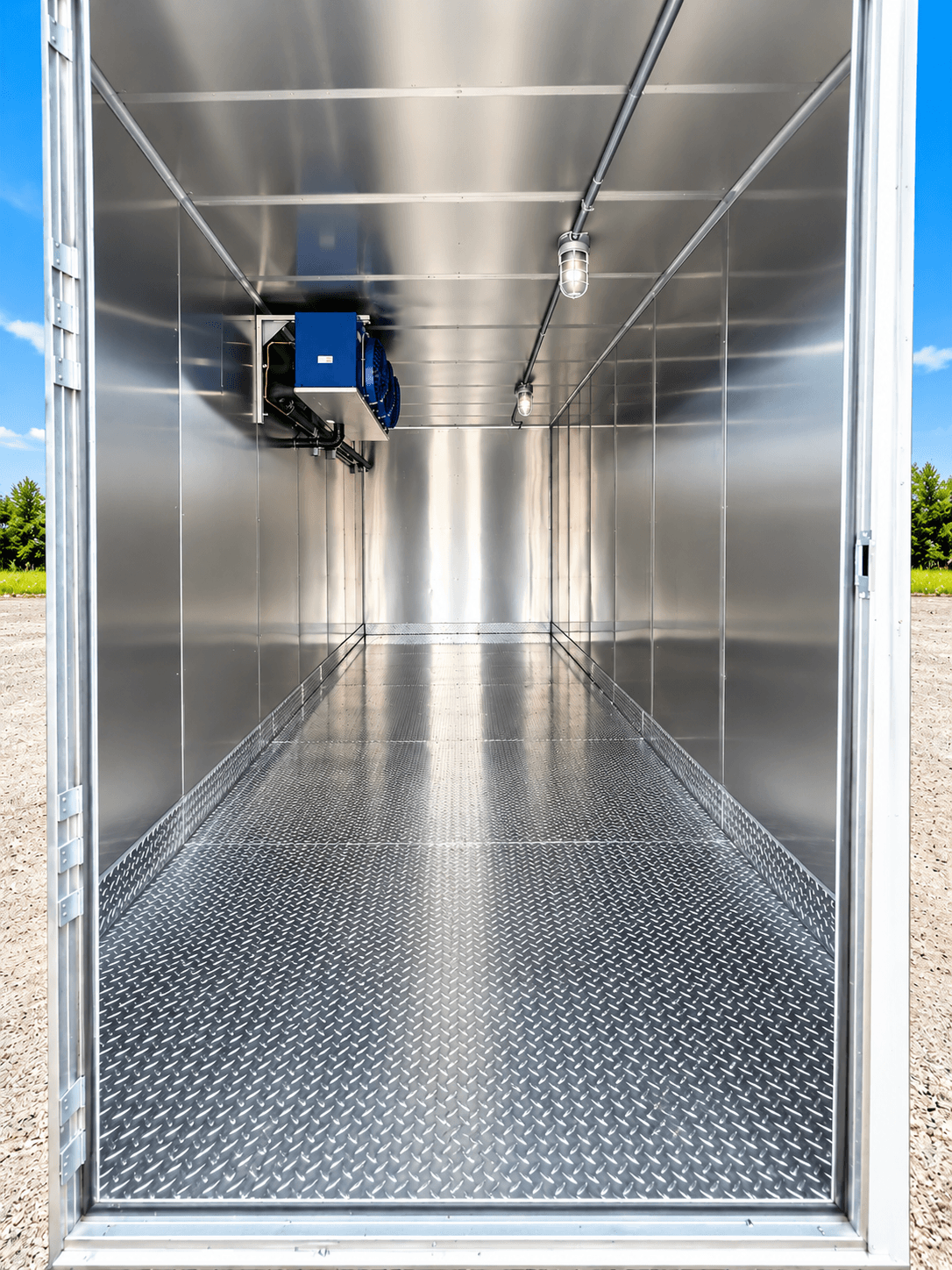
Compare the equipment
These published examples describe named company units. The supplied equipment, configuration and availability are confirmed for your project address.
Listed refrigeration trailer equipment: condensing unit, amps panel, lighting.
Equipment records reviewed October 19, 2026. Temperature labels are inventory labels, not verified operating ranges. Nominal length is a model label, not a measure of usable space or site footprint.
When the commercial walk-in freezer or cooler fails at a hotel banquet kitchen in Amherst, an emergency mobile refrigeration trailer rental can hold the affected stock while the permanent unit is repaired. Emergency rentals and planned leases are quoted from the same details: the product, the temperature it must hold, the address and the dates. Kitchen outages often bring more than one need: a mobile kitchen for rent for cooking, a dishwashing trailer lease for warewashing and refrigerated storage for the ingredients.
Trailers for rent and trailer leasing cover emergency, short-term and long-term needs, from portable walk-in coolers to outdoor walk-in refrigeration for commercial sites. Photos of the failed unit or the available space can help the team understand the request. Walk-in coolers, walk-in freezers and refrigerated trailers cover most requests. Hotels, grocers, hospitals and commissaries can reach a person at any hour, because rental inquiries are answered 24/7. Facilities in Lowell, Cambridge and Boston often ask the same questions as Amherst operators: how long the rental will last, whether a lease makes sense and what the site needs for power and truck access.
A Massachusetts state document says the Eastern States Exposition, the Big E, is a 17-day annual event in West Springfield that ranks as the fourth-largest fair in the United States and drew more than 1.6 million visitors in 2023. Seasonal growers and packers in Chicopee, Agawam Town and Agawam can compare a short-term refrigerated trailer rental with a long-term container lease for harvest and holiday peaks. Food producers in Palmer Town and Southbridge Town can ask about trailer leasing for seasonal stock or a temporary overflow. Refrigerated trailers for rent and portable walk-in coolers hold drinks, produce and prepared food at crowded events, and a refrigeration container suits a longer festival run. Refrigerated trailers for rent, refrigeration containers for lease and walk-in coolers for short-term use are the three questions most callers start with. Dishwashing trailer rentals and warewashing capacity are quoted beside the kitchen and refrigeration when the whole food-service area is affected. Kitchen, dishwashing and refrigeration rentals are separate equipment, and each can be rented short-term or leased long-term. A dishwashing trailer lease can be added to the same quote when returned dishes also need washing. Nothing here assumes available equipment or a delivery time; a person answers rental inquiries 24/7 and the quote confirms the details.

The October 2011 snowstorm cut power to roughly 670,000 Massachusetts customers, with snowfall topping 27 inches in Plainfield, and hundreds of thousands of western Massachusetts residents were without power for almost a week. A freezer failure at a nursing home in Southbridge, a cafeteria in Greenfield or a bakery in Gardner can start with a phone call and a short list of details: the address, the stock and the temperature to hold. A restaurant in Brockton or a care home in Quincy can call about an emergency freezer rental as soon as the temperature alarm goes off. A failed commercial walk-in freezer after an outage is an emergency call, and walk-in coolers, walk-in freezers and refrigerated trailers are the first rentals discussed. Trailer rentals, trailers for rent and trailer leasing are all discussed with the address and the dates in hand. A mobile dishwashing trailer and a mobile kitchen trailer are often requested together, with a refrigerated trailer for the stock. This is published public context, not company work; each request is quoted for its own address and dates.
MassDOT’s March 2026 highway report lists the I-90/I-495 interchange reconstruction in Hopkinton and Westborough, with a bid of about $394 million, as the largest 2026 contract, and Springfield’s Sumner Avenue reconstruction, known as The X, with crews working through fall 2026. Seasonal refits in Marlborough, Leominster and Lynn can be covered by a lease that starts before demolition and ends after the stock moves back indoors. Facility teams in Fall River can lease portable refrigeration as temporary facilities while a permanent cold room is rebuilt. A long-term refrigeration trailer lease keeps supplies cold on site for the whole project, with power and access reviewed before delivery. These are public facts about the area, not a record of company jobs; equipment, availability and delivery are confirmed in the quote.
A short-term emergency rental can become a long-term lease at the same address, as long as the quote says so. A dishwashing trailer, a mobile kitchen trailer and a refrigerated trailer for rent can each be short-term or long-term, depending on the repair. Emergency refrigeration can be arranged as a refrigerated trailer, a refrigeration container or a portable walk-in cooler, depending on the stock and the site. Modular and portable cold storage can be discussed in stages when a site needs more space than one refrigerated trailer provides.
Emergency refrigeration in Amherst can be rented for a few days or leased long-term, depending on how long the commercial walk-in is down. Mobile kitchens, dishwashing trailers and refrigerated trailers for rent can be quoted together as temporary facilities. A portable refrigerated trailer suits most emergency calls, while a refrigeration container fits a longer, more stationary need. When cooking and dish washing stop with the walk-in freezer, a mobile kitchen, a dishwashing trailer and portable refrigeration can be one request.
A dishwashing trailer lease can be added to the same quote when returned dishes also need washing. Dishwashing and kitchen outages often arrive together, so dishwashing trailer rentals and a mobile kitchen for rent are quoted beside emergency refrigeration. Dishwashing trailer rentals and kitchen trailer rentals can be quoted alongside refrigerated trailers for rent when the whole kitchen is down. In Amherst, emergency refrigeration usually means a refrigerated trailer, a refrigeration container or a portable walk-in cooler matched to the stock.
A commercial walk-in freezer failure in Amherst is an emergency call, and onsite temporary refrigeration is how most such calls begin. Portable refrigerated trailers, refrigeration containers and outdoor walk-in refrigeration units can all be discussed for the same emergency. Temporary facilities can be arranged onsite for an event, a renovation or an emergency, and collected when the permanent kitchen is ready. Modular, mobile or portable, the equipment is chosen to fit the work that continues at the site.
Emergency refrigeration, onsite and temporary, is meant to bridge the gap until the commercial walk-in freezer is repaired or replaced. Portable refrigeration is not a permanent fix; it is a set of temporary facilities for the weeks between a failure and a repaired walk-in freezer.
NOAA’s Massachusetts summary records extensive flooding from three intense March 2010 rainstorms. That state and regional history does not establish damage at an Amherst premises today. A refrigeration contingency should identify the assessed fault and the facilities currently usable, with product-use decisions made by the responsible operator rather than inferred from historical weather.
An occupied institutional site may retain preparation and meal service while losing reserve storage. List the ingredients needed for the next service and the supplier loads already ordered. The cold-storage request should show which products require transfer and which can remain inside. If different departments share supplies, nominate one person to maintain the working record so a changed repair estimate does not produce conflicting receiving instructions.
The 20ft Refrigerated Trailer guide fits a project like this one, focused on occupied campus facilities, and walks through a load estimate before choosing a length as well as how a trailer compares with a container on the same site.
UMass Amherst’s May 24, 2024 notice described utility work and a pedestrian detour for the Sustainable Engineering Laboratories construction site. It is dated owner evidence of construction affecting circulation on an occupied campus. It does not establish current restrictions, a food-service requirement or any equipment supplied by our company.
Readers in Amherst may also want to compare how other nearby cities approach their projects. Springfield’s guide focuses on commercial food-service recovery, and a separate reading is Worcester’s guide on commercial meal service. Use them to prepare questions, not to infer availability or terms for Amherst.
A comparable dining refurbishment should identify the interface between retained operations and the contractor’s boundary. Permanent refrigeration may remain outside the main work area but lose its ordinary retrieval route. Explain which phase changes access and who can approve an alternative. Temporary storage dates need to follow that operational interruption, rather than a general building completion forecast.
When a school dining area closes unexpectedly in Amherst or Northampton, Massachusetts, incoming ingredients may need a temporary destination before the next scheduled meal service. Confirm which staff member accepts supplier deliveries, how access changes are communicated, and where unresolved receiving questions should be directed.
The dining team may need stock before students, employees or visitors use a refurbished space. Identify the first receiving date, preparation period and permanent storage acceptance step individually. A refrigerated trailer inquiry should explain the highest inventory overlap and how staff retrieve products. A large institutional purchasing total does not show what belongs at the particular temporary store.
For another comparison, the guide for operators in Pittsfield covers phased commercial reopening, citing the Berkshire Museum entry “December 3, 2024 renovation programme release”. Use it as a prompt for your own questions about timing, access and storage.
An institution drawing support from Northampton, Easthampton and Holyoke can brief a visiting kitchen team before the Amherst move: identify stock assigned to the premises, the next meal commitment and the accepted retrieval route. A regional purchasing list alone will not answer those questions. Dishwashing containers should have a named return point when a corridor closes. The temporary plan then remains usable by staff who do not know the building's ordinary back-of-house routine.
Provide photographs and measurements from the owner-approved entrance to the intended refrigerated unit position. Show gates, overhead restrictions, contractor barriers and pedestrian circulation. A public campus entrance may not be the service entrance approved for equipment transport. Identify the site’s check-in procedure and the person authorized to receive the delivery.
Utility information should come from the responsible premises team for review. Staff need a usable route to cold storage through every relevant work phase, not merely at the initial placement. Protect collection access after paving, landscaping or fencing is reinstated. When a detour or work boundary changes, send a revised layout before the earlier transport plan is relied upon.
Send the full address, required product conditions, maximum anticipated stock and preferred period. Explain uncertain repair or commissioning decisions. Ask the refrigeration proposal to distinguish equipment rental, transport and other charges clearly, with a process for reviewing a changed start or finish. Confirm availability and preparation responsibilities before using the arrangement to coordinate dependent closures.
If mobile kitchen or dishwashing facilities are needed, identify their actual tasks and operating periods separately. Clarify who can accept the site and release each product transfer. The final request should give the commercial operator and project manager a shared operating sequence, without assuming equipment inventory, guaranteed timing or conditions at the customer’s property from a public campus construction notice.
Before you book
Yes, if it changes how staff retrieve ingredients or separates a storage room from preparation. Describe the actual restriction and the approved route, rather than assume a dated public notice remains current.
Identify the inventory assigned to the affected premises and its highest overlap with deliveries. A refrigeration proposal needs the operating requirement at that address, not the institution’s combined purchasing figure.
The operator should accept the permanent cooler and agree a usable route. Building completion or a public opening date alone does not establish that the storage system is ready for normal use.
The team can discuss a mobile refrigeration trailer rental or lease for a Amherst address, from a few days to several months. Useful details are the address, the quantity of stock, the required temperature and the expected dates. Equipment, availability and delivery timing are confirmed in the quote.
Mobile and modular refrigeration, from refrigerated trailers for rent to a refrigeration container lease, can be discussed for short-term or long-term needs. Onsite refrigeration keeps product close to the kitchen door, so a temporary unit can be used the way the permanent walk-in was. Trailer rentals for emergencies are usually short-term, while trailer leasing for construction or seasonal work can run for months. A commercial walk-in freezer or refrigeration breakdown is an emergency, so call at any hour; a person answers rental inquiries 24/7, and the quote confirms the equipment and delivery for your address.
These public references inform the planning examples; equipment availability and delivery arrangements are confirmed for your address.
Temporary refrigeration, kitchens and dishwashing can support many kinds of food-service operations. Each setting below starts with its own schedule, stock and site questions, and every project is reviewed individually.
Hotels, restaurants and resorts can plan temporary refrigeration around breakfast, banquet and dinner service when a walk-in cooler fails or a kitchen is refurbished.
Hospital, nursing home and care-facility kitchens can describe meal schedules, delivery times and displaced stock so temporary storage follows the food-service routine.
Municipal, county and public-building food-service teams can outline receiving arrangements, responsible contacts and project dates before a quote is prepared.
Dining facility managers can explain the products displaced, the receiving arrangements and the proposed period, then review availability and terms with our team.
Schools, colleges and universities can plan around term dates, serving windows and campus kitchen renovations so meal service can continue during repairs or construction.
Plant cafeterias and employee dining areas can describe shift patterns and staged building work so temporary cold storage can be reviewed against the working schedule.
Caterers and venues can plan preparation windows, event days and overflow ingredients, and describe how stock moves between storage, the kitchen and service.
Producers, wholesalers and distributors can describe loading, staging and storage needs when a cooler breaks down or demand temporarily exceeds capacity.
These examples describe planning situations. Equipment, availability and terms are confirmed in a project quote.
Cold storage is only one part of a project. These are the questions we work through with you before anything is booked.
Start with refrigerated containers and refrigeration trailers, then add a temporary kitchen or dishwashing trailer when the project needs one, all in a single conversation.
Access, utilities and the intended position are reviewed before delivery is arranged, so the equipment is matched to your site rather than the other way around.
Whether a walk-in cooler failed this morning or a renovation is months away, describe the real situation and plan around the stock, dates and people involved.
Planning guides cover all 50 states and more than 700 cities. Your address is then confirmed for equipment and delivery.
Use the rental calculator for a rate-range estimate and setup amount, then request a project quote that confirms availability, transport and the rental period.