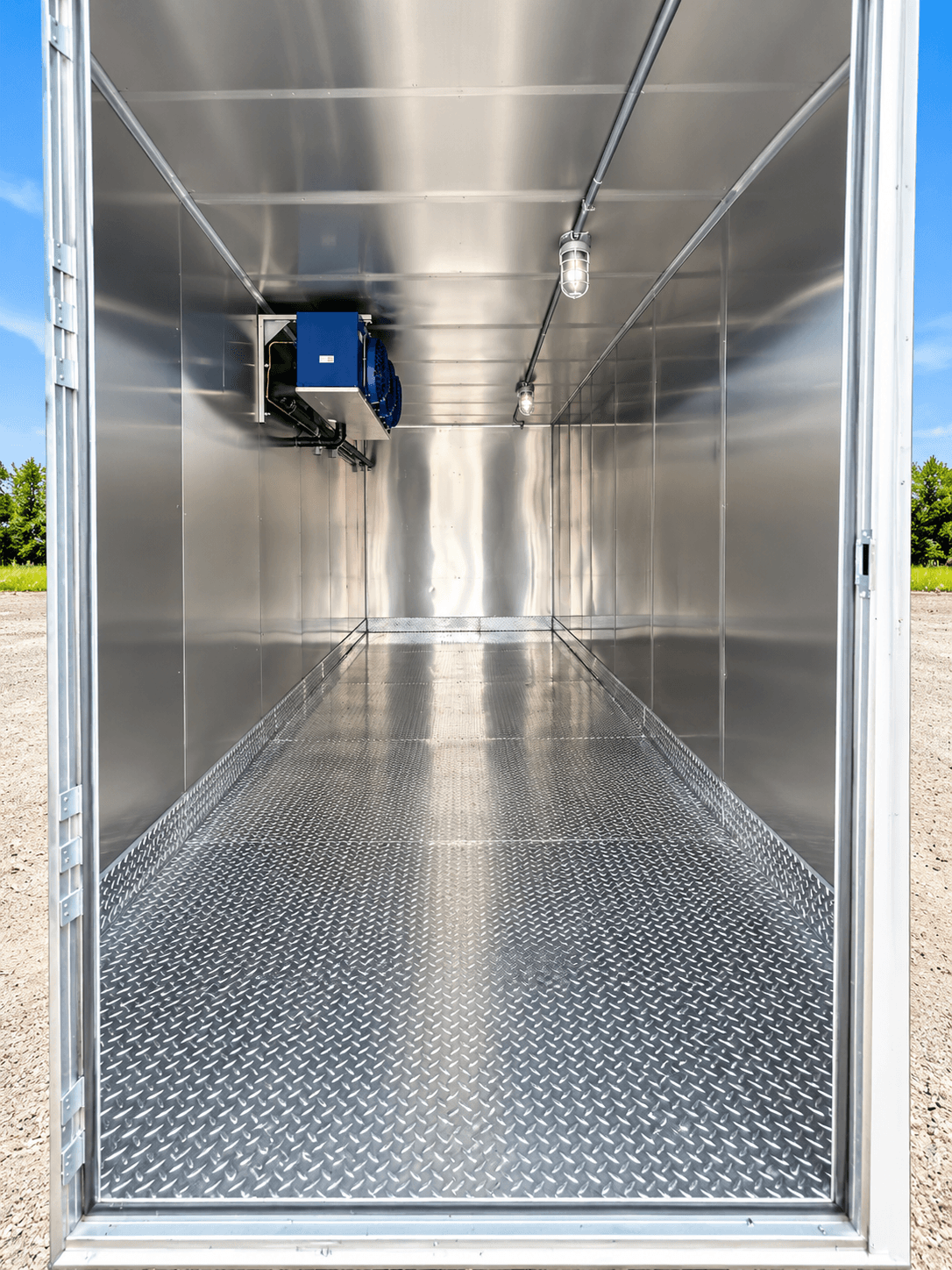
BXRT20–1Refrigerated trailer
- Nominal length
- 20ft
- Listed electrical supply
- 220V · single-phase · 40–60A
- Inventory temperature label
- 32°F
Temporary cold storage in Johnstown, Pennsylvania
Johnstown refrigerated container rentals can be considered with kitchen and dishwashing rentals when existing food-service rooms need temporary alternatives. Emergency commercial freezer breakdowns and planned recommissioning create different transfer decisions. Short-term rentals and longer leasing requests can be discussed for industrial operators, institutions, restaurants, venues and other commercial customers. Delivery coordination should identify the proposed placement, approved service entrance and a person responsible for access throughout the work. Explain your refrigeration requirement, the stock remaining in permanent rooms and the acceptance milestones for returning it. Request availability and an address-specific quote from Worldwide Refrigerated Container Rental Facilities before relying on a temporary arrangement for the reopening sequence.
Emergency cooler or freezer failure in Johnstown? A person answers rental inquiries 24/7. Availability and delivery timing are confirmed in your quote.
Plan your rental budget
Compare the equipment
These published examples describe named company units. The supplied equipment, configuration and availability are confirmed for your project address.
Listed refrigeration trailer equipment: condensing unit, amps panel, lighting.
Equipment records reviewed October 19, 2026. Temperature labels are inventory labels, not verified operating ranges. Nominal length is a model label, not a measure of usable space or site footprint.
Emergency refrigeration rental in Johnstown often starts with one decision: whether the stock belongs in a portable walk-in freezer for rent or in a different format, such as a rented walk-in freezer. Whether you rent for a weekend event or lease through a multi-month renovation, the rental period, delivery coordination and setup are confirmed in your quote. Cold storage is the usual starting point, and the same team can discuss a mobile kitchen rental or a dishwashing trailer lease if the interruption is wider.
Portable, mobile and modular refrigeration can be arranged onsite as temporary facilities for commercial kitchens, warehouses and food plants, for short-term or long-term use. A person answers rental inquiries 24/7, so an emergency in Johnstown can be reported at any hour, including nights, weekends and holidays. Teams working in Chambersburg, Gettysburg and Harrisburg, as well as Johnstown, can ask for trailer rental or leasing details for their own address, since equipment and delivery are reviewed site by site.
A Penn State release says the five-day Central Pennsylvania Festival of the Arts draws approximately 125,000 visitors to State College each year. Distributors and processors in Bellefonte, Lewistown and Huntingdon can compare a short-term refrigeration trailer rental with a long-term lease for outdoor walk-in refrigeration. Stadium concessions in Tyrone and venues in Williamsport may need temporary facilities for a season, so a trailer lease can fit better than repeated short rentals. Portable refrigerated trailers and walk-in coolers are usually the first equipment discussed for event stock, with onsite power and access reviewed early. Onsite temporary facilities can include portable refrigeration, trailers for rent and, if dishes are affected, a dishwashing trailer. Dishwashing trailer rentals and warewashing capacity are quoted beside the kitchen and refrigeration when the whole food-service area is affected. Kitchen, dishwashing and refrigeration rentals are separate equipment, and each can be rented short-term or leased long-term. This is published public context, not company work; each request is quoted for its own address and dates.
When the remnants of Tropical Storm Lee flooded the Susquehanna River in September 2011, about 75,000 people in Wilkes-Barre and nearby riverfront towns were ordered out, Harrisburg evacuated 6,000 to 10,000 residents of low-lying areas, and the river reached the second-highest level recorded at Wilkes-Barre. A walk-in failure at a restaurant in Scranton, a hospital kitchen in Taylor or a hotel in Dunmore usually calls for the same first step: a refrigerated trailer rental or container lease sized to the stock. A restaurant in Moosic or a food distributor in Bethlehem can call about emergency refrigeration rental as soon as a walk-in stops holding temperature. Emergency refrigeration comes first after a storm or outage: a portable refrigerated trailer, a refrigeration container or outdoor walk-in refrigeration can hold stock while power and repairs catch up. Portable refrigerated trailers, refrigeration containers and outdoor walk-in refrigeration units can all be discussed for the same job. When cooking and dish washing stop together, a mobile kitchen, a dishwashing trailer and portable refrigeration can be one request. These are public facts about the area, not a record of company jobs; equipment, availability and delivery are confirmed in the quote.
PennDOT announced a record $655 million in 67 new road and bridge projects across northeast Pennsylvania for 2026, and $1.2 billion in 157 projects improving 197 miles of roads and 77 bridges across eastern Pennsylvania. Seasonal refits in Allentown, Reading and Lebanon can be covered by a lease that starts before demolition and ends after the stock moves back indoors. Facility teams in Catasauqua can lease portable refrigeration as temporary facilities while a permanent cold room is rebuilt. Trailer leasing covers the length of a project: a refrigerated trailer for supplies, portable kitchen trailers for crew meals and a dishwashing trailer when plates need washing. Walk-in coolers hold chilled stock and walk-in freezers hold frozen stock, so the rental should match whichever one is needed. A dishwashing trailer lease can be added to the same quote when returned dishes also need washing. Nothing here assumes available equipment or a delivery time; a person answers rental inquiries 24/7 and the quote confirms the details.
Short-term or long-term, trailers for rent in Johnstown are quoted for the address, the stock and the dates. Onsite temporary facilities can include portable refrigeration, a mobile kitchen trailer and, if dishes are affected, a dishwashing trailer. Outdoor walk-in refrigeration needs level ground and power nearby, so a long-term lease starts with a site conversation. For Johnstown kitchens, plants and warehouses, trailer leasing and trailer rentals are two ways to get the same portable refrigerated storage.
In Johnstown, emergency refrigeration usually means a refrigerated trailer, a refrigeration container or a portable walk-in cooler matched to the stock. A commercial walk-in freezer failure in Johnstown is an emergency call, and onsite temporary refrigeration is how most such calls begin. Refrigerated trailers for rent, refrigeration containers for lease and walk-in coolers for short-term use are the three questions most callers start with. Short-term or long-term, the same refrigerated trailer rental starts from the address, the stock and the dates.
Dishwashing and kitchen outages often arrive together, so dishwashing trailer rentals and a mobile kitchen for rent are quoted beside emergency refrigeration. Portable refrigerated trailers, refrigeration containers and outdoor walk-in refrigeration units can all be discussed for the same emergency. Outdoor walk-in refrigeration can be set up beside the building as temporary facilities, so staff keep working while the permanent walk-in cooler or walk-in freezer is repaired. A commercial walk-in freezer that fails overnight is an emergency, and so is a commercial refrigeration system that stops holding temperature.
A mobile dishwashing trailer and a mobile kitchen trailer are often requested together, with a refrigerated trailer for the stock. Trailer leasing makes sense when a commercial kitchen will be closed for weeks, because one lease replaces repeated short-term rentals. A mobile kitchen trailer for rent can sit beside onsite refrigeration, so cooking and cold storage are planned together. Emergency refrigeration can be arranged as a refrigerated trailer, a refrigeration container or a portable walk-in cooler, depending on the stock and the site.
A commercial kitchen closed for repairs may need a mobile kitchen trailer lease, a dishwashing trailer and emergency refrigeration at the same time. A portable refrigerated trailer suits most emergency calls, while a refrigeration container fits a longer, more stationary need. Temporary facilities for a commercial site usually mean refrigeration first, then a mobile kitchen or dishwashing trailer if cooking or washing is also interrupted.
The U.S. Geological Survey’s 1978 report documents the July 19–20, 1977 floods in the Johnstown area. NOAA’s 2022 Pennsylvania summary supplies broader state climate context. These records make continuity planning locally relevant, but they do not establish current conditions or suitability at a particular property. After an interruption, confirm usable site access before requesting refrigeration placement. Identify which goods remain in working equipment and which need another destination. Kitchen activity may restart before every service room is available, while dishwashing can have a separate restoration sequence. A freezer inquiry should explain those operating decisions and identify the person responsible for the goods, rather than treating a historical flood as a substitute for a current site assessment.
When the work involves recommissioning existing rooms, the 20ft Refrigerated Container guide is a practical next read, covering one resting place for the whole project and protection for the power connection before a quote is requested.
The University of Pittsburgh identifies its John P. Murtha Engineering and Science Building renovation at the Johnstown campus as LEED certified in 2024. This owner record concerns the regional campus setting, not a food-service rental or a claim that all campus buildings sit within Johnstown’s municipal boundary. It is a dated example of investment in existing space. A separate operator recommissioning a service room should identify what operating checks remain after physical work is complete. Temporary cold storage may still be needed while goods are organized and permanent equipment is accepted. Give the inquiry those practical handover steps rather than using the completion of unrelated building work to infer a storage deadline.
For comparison, read what nearby cities emphasize. In Altoona, the guide covers seasonal building shutdowns, citing the Penn State entry “Adler Athletic Complex approval, November 2015”; in Pittsburgh, it covers shift food service. Neither guide describes Johnstown itself, and both depend on their own site details.
A college food service team in Johnstown or Windber, Pennsylvania, may need temporary equipment while permanent facilities undergo repairs and classes continue on campus. Identify where staff will check incoming ingredients, retain delivery records and report a mismatch between an order and its contents.
A hypothetical Johnstown refurbishment may replace surfaces, services and fixed equipment in different stages. The operating team should define when a permanent refrigerated room is ready for the goods it holds and who can approve that return. Kitchen reopening and dishwashing reopening may each depend on separate work, so avoid one unexplained date for the whole service area. List the freezer stock still assigned to temporary storage and mark the goods needed during each shift. A room that looks finished can still be awaiting the operator’s acceptance or shelving arrangement. Keep the rented unit’s purpose visible until the transfer is complete, with purchasing told when normal receiving can safely use the permanent location again.
A further point of reference is State College’s guide, which covers busy-calendar receiving plans, citing the Penn State athletics entry “stadium renovation approval, May 21, 2024”. Its details belong to that city and do not describe Johnstown.
Westmont, Windber and Ebensburg are distinct nearby communities whose receiving properties need their own address and entrance information. If a regional organization coordinates from Johnstown, label the actual refrigerated equipment destination clearly. At an existing building, restoration work can change the route staff use even without altering the public front entrance. Show the placement position, on-site approach and any area that must remain available to other users. Identify the person authorized to approve the route and update it as work progresses. Cold storage may outlast temporary fencing or contractor supervision, so the collection plan must reflect the site after those arrangements end rather than assuming setup conditions continue indefinitely.
A refrigeration request should describe quantities, packaging, required conditions and the expected stock-return sequence. Give the proposed rental dates, current placement photographs and site electrical information from an appropriate representative. Explain whether the permanent room is being repaired, refurbished or recommissioned after a longer closure, since those situations can have different uncertainties. Ask the proposal to clarify equipment suitability, rental period, transport and collection assumptions, plus how an extension would be reviewed. Availability and final charges require an address-specific assessment. A named acceptance milestone gives purchasing a stronger basis for the intended period than an optimistic finish date with no assigned stock-transfer responsibility or plan for delayed operating checks.
Before you book
The operating team should establish acceptance for the actual goods and confirm which checks remain. Share that milestone in the inquiry and distinguish it from the contractor’s physical finish. A refrigerated transfer should follow the approved operating plan rather than the appearance of the room alone.
No. Historical records explain local context, while present access must be checked for the actual property and dates. Give the reviewer current information from the authorized site team and identify any known limits affecting the proposed placement, approach or later collection.
Describe the goods moved in each stage and whether new deliveries arrive during that interval. Identify the last stock expected to leave temporary storage. Ask the agreement to address the full period and any revised collection plan instead of assuming the first transfer ends the rental.
A short rental usually suits a repair, while a longer lease suits a renovation or a seasonal peak. Include the address, how a truck can reach the site, the power available and the temperature the product must hold. Equipment availability, delivery arrangements and setup are confirmed in the quote, not assumed.
Emergency refrigeration can include portable refrigerated trailers, a refrigeration container, outdoor walk-in refrigeration or a walk-in cooler or walk-in freezer rental. Mobile refrigeration, mobile kitchens and mobile dishwashing trailers are different equipment, and each can be rented separately or together. A mobile, modular or portable refrigeration setup in Johnstown is chosen to match the walk-in cooler or freezer that failed. Refrigeration is an emergency need, so describe the failed commercial unit and the stock at risk. The quote confirms availability, delivery and the rental period for the site.
These public references inform the planning examples; equipment availability and delivery arrangements are confirmed for your address.
Temporary refrigeration, kitchens and dishwashing can support many kinds of food-service operations. Each setting below starts with its own schedule, stock and site questions, and every project is reviewed individually.
Hotels, restaurants and resorts can plan temporary refrigeration around breakfast, banquet and dinner service when a walk-in cooler fails or a kitchen is refurbished.
Hospital, nursing home and care-facility kitchens can describe meal schedules, delivery times and displaced stock so temporary storage follows the food-service routine.
Municipal, county and public-building food-service teams can outline receiving arrangements, responsible contacts and project dates before a quote is prepared.
Dining facility managers can explain the products displaced, the receiving arrangements and the proposed period, then review availability and terms with our team.
Schools, colleges and universities can plan around term dates, serving windows and campus kitchen renovations so meal service can continue during repairs or construction.
Plant cafeterias and employee dining areas can describe shift patterns and staged building work so temporary cold storage can be reviewed against the working schedule.
Caterers and venues can plan preparation windows, event days and overflow ingredients, and describe how stock moves between storage, the kitchen and service.
Producers, wholesalers and distributors can describe loading, staging and storage needs when a cooler breaks down or demand temporarily exceeds capacity.
These examples describe planning situations. Equipment, availability and terms are confirmed in a project quote.
Cold storage is only one part of a project. These are the questions we work through with you before anything is booked.
Start with refrigerated containers and refrigeration trailers, then add a temporary kitchen or dishwashing trailer when the project needs one, all in a single conversation.
Access, utilities and the intended position are reviewed before delivery is arranged, so the equipment is matched to your site rather than the other way around.
Whether a walk-in cooler failed this morning or a renovation is months away, describe the real situation and plan around the stock, dates and people involved.
Planning guides cover all 50 states and more than 700 cities. Your address is then confirmed for equipment and delivery.
Use the rental calculator for a rate-range estimate and setup amount, then request a project quote that confirms availability, transport and the rental period.