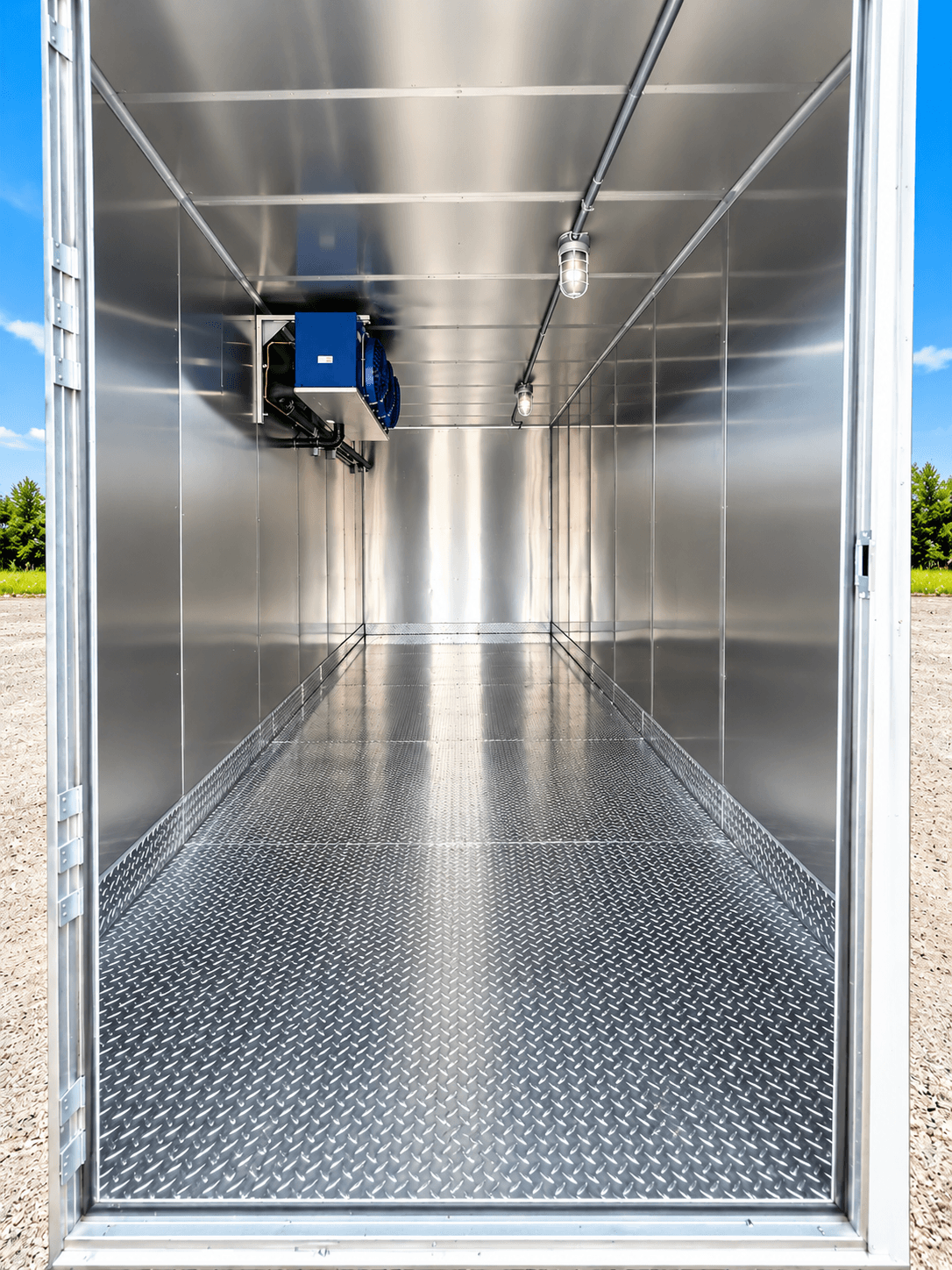
BXRT20–1Refrigerated trailer
- Nominal length
- 20ft
- Listed electrical supply
- 220V · single-phase · 40–60A
- Inventory temperature label
- 32°F
Temporary cold storage in Napa, California
Napa refrigerated container leasing gives commercial operators a practical starting point when a walk-in or refrigeration unit breaks down. Planned hospitality renovations can also displace storage, with mobile kitchen and dishwashing arrangements reviewed alongside the interruption. Restaurants, caterers, institutional dining services and industrial food businesses can inquire about short-term rentals or longer lease periods. Delivery coordination needs the real placement address, authorized access and suitable connections for the equipment proposed. Explain what must remain available during the work, then request availability and a quote from Worldwide Refrigerated Container Rental Facilities based on your Napa operating schedule.
Emergency cooler or freezer failure in Napa? A person answers rental inquiries 24/7. Availability and delivery timing are confirmed in your quote.
Plan your rental budget
Compare the equipment
These published examples describe named company units. The supplied equipment, configuration and availability are confirmed for your project address.
Listed refrigeration trailer equipment: condensing unit, amps panel, lighting.
Equipment records reviewed October 19, 2026. Temperature labels are inventory labels, not verified operating ranges. Nominal length is a model label, not a measure of usable space or site footprint.
Renting a refrigeration container in Napa gives a school cafeteria somewhere to put chilled and frozen stock while a failed compressor, door or walk-in is repaired. The same equipment can be rented for a few days or leased for several months, depending on how long the permanent storage will be out of service. Cold storage is the usual starting point, and the same team can discuss a mobile kitchen rental or a dishwashing trailer lease if the interruption is wider.
Trailers for rent and trailer leasing cover emergency, short-term and long-term needs, from portable walk-in coolers to outdoor walk-in refrigeration for commercial sites. Hotels, grocers, hospitals and commissaries can reach a person at any hour, because rental inquiries are answered 24/7. Businesses in Napa and across the state, including those in Richmond, Santa Rosa and Concord, can ask about emergency rentals or longer leases using the same inquiry. Availability, delivery arrangements and the rental period are confirmed in the quote for each address.
An events-industry report puts Coachella attendance in Indio at about 750,000 for 2023 and the Rose Parade in Pasadena at roughly 250,000 in-person spectators, figures it attributes to other sources. Food distributors in San Marino, South Pasadena and Glendale can ask about leasing a refrigeration trailer for overflow stock when permanent coolers are full. Food producers in La Cañada Flintridge and El Monte can ask about trailers for rent when production outgrows permanent cold storage for a few weeks. Portable refrigerated trailers and walk-in coolers are usually the first equipment discussed for event stock, with onsite power and access reviewed early. Walk-in coolers hold chilled stock and walk-in freezers hold frozen stock, so the rental should match whichever one is needed. Nothing here assumes available equipment or a delivery time; a person answers rental inquiries 24/7 and the quote confirms the details.
CAL FIRE’s retrospective on the November 8, 2018 Camp Fire in Butte County records at least 85 civilian deaths, 153,336 acres burned and more than 18,000 structures destroyed, with most of the damage in Paradise and Concow. When a compressor fails at a grocery in Chico, a school in Orland or a care facility in Corning, an emergency walk-in cooler or freezer rental can protect the food while repairs are arranged. Schools in Tehama and a distributor in Yuba City can ask the same question: what equipment fits this address, and what will the quote confirm about delivery? After an outage or storm, refrigerated trailers for rent and walk-in freezers protect frozen stock first, and the quote confirms equipment and delivery. Onsite temporary facilities can include portable refrigeration, trailers for rent and, if dishes are affected, a dishwashing trailer. These are public facts about the area, not a record of company jobs; equipment, availability and delivery are confirmed in the quote.
A California state Senate budget document gives 2032 as the updated completion date for the Merced–Bakersfield early operating segment of high-speed rail, with fare service beginning in 2033. Construction crews and facility managers near Shafter, Arvin and McFarland may lease refrigerated containers to hold food for a work site or a temporary dining area. Facility teams in Lancaster can lease portable refrigeration as temporary facilities while a permanent cold room is rebuilt. Trailer leasing covers the length of a project: a refrigerated trailer for supplies and a refrigeration container for bulk stock, short-term or long-term. When cooking and dish washing stop together, a mobile kitchen, a dishwashing trailer and portable refrigeration can be one request. Dishwashing trailer rentals and warewashing capacity are quoted beside the kitchen and refrigeration when the whole food-service area is affected. The context above comes from public sources and does not describe a completed job; availability and delivery are confirmed in the quote.
Short-term rental suits a repair, and long-term leasing suits a renovation, so ask the quote to say which applies. Dishwashing and kitchen outages often arrive together, so dishwashing trailer rentals and a mobile kitchen for rent are quoted beside emergency refrigeration. Dishwashing trailer rentals and kitchen trailer rentals can be quoted alongside refrigerated trailers for rent when the whole kitchen is down. A portable refrigerated trailer suits most emergency calls, while a refrigeration container fits a longer, more stationary need.
Temporary facilities can be arranged onsite for an event, a renovation or an emergency, and collected when the permanent kitchen is ready. Outdoor walk-in refrigeration can be set up beside the building as temporary facilities, so staff keep working while the permanent walk-in cooler or walk-in freezer is repaired. Portable refrigerated trailers, refrigeration containers and outdoor walk-in refrigeration units can all be discussed for the same emergency. Modular, mobile or portable, the equipment is chosen to fit the work that continues at the site.
Emergency refrigeration, onsite and temporary, is meant to bridge the gap until the commercial walk-in freezer is repaired or replaced. A mobile dishwashing trailer and a mobile kitchen trailer are often requested together, with a refrigerated trailer for the stock. Emergency refrigeration rental covers walk-in coolers, walk-in freezers and refrigerated trailers for commercial kitchens, warehouses and plants. Mobile kitchens, dishwashing trailers and refrigerated trailers for rent can be quoted together as temporary facilities.
Onsite temporary facilities can include portable refrigeration, a mobile kitchen trailer and, if dishes are affected, a dishwashing trailer. Emergency refrigeration can be arranged as a refrigerated trailer, a refrigeration container or a portable walk-in cooler, depending on the stock and the site. Emergency refrigeration for commercial kitchens often starts with a portable refrigerated trailer and ends with a longer lease if repairs take time. Kitchen, dishwashing and refrigeration rentals are separate equipment, and each can be rented short-term or leased long-term.
A dishwashing trailer lease can be added to the same quote when returned dishes also need washing. A mobile, modular or portable refrigeration setup in Napa is chosen to match the walk-in cooler or freezer that failed. A commercial walk-in freezer failure in Napa is an emergency call, and onsite temporary refrigeration is how most such calls begin. In Napa, emergency refrigeration usually means a refrigerated trailer, a refrigeration container or a portable walk-in cooler matched to the stock.
Short-term or long-term, the same refrigerated trailer rental starts from the address, the stock and the dates. A mobile kitchen trailer for rent can sit beside onsite refrigeration, so cooking and cold storage are planned together.
When a previous interruption has coincided with a booked event, the purchasing record can reveal two different needs: ingredients already committed to service and replenishment for the following days. Build the Napa refrigeration request around both. Identify which supplies have a fixed use date, which remain unopened and who can revise orders if the permanent system is unavailable longer than expected.
NOAA’s California summary documents historic wet periods as well as drought; neither establishes the condition of a particular property today. Review your own interruption records for access problems, staff handovers and missing stock information. A caterer coordinating preparation in Yountville should identify where each batch will actually be stored, rather than assume a nearby location makes transfer permission or cold-storage space available.
Planning food-service renovations raises equipment questions that the 20ft Refrigerated Container guide answers in more detail, including protection for the power connection and one resting place for the whole project.
Napa’s parking-garage feasibility page describes work beginning in winter 2026 and a community open house on May 27, 2026. Its purpose is to evaluate potential downtown parking options. This is planning context, not a statement that a garage is under construction or that a particular loading entrance is closed. Public project notices should be read for their stated stage.
Two nearby cities approach their projects differently. Vallejo’s guide addresses commercial building work, citing the City of Vallejo entry “proposed FY2025–26 through FY2029–30 capital plan”, while the guide for operators in Fairfield addresses planning during commercial refurbishment. Bring the same practical questions about access, timing and storage to your Napa inquiry.
For your own commercial refurbishment, use the same discipline when choosing a refrigeration start date. A concept drawing, a landlord’s approval and a contractor’s confirmed start carry different levels of certainty. Ask which decision actually removes access to permanent storage. If the work could shift, describe the provisional period and the point when the rental proposal needs to be reviewed.
At an industrial workplace in Napa or Yountville, California, a changed contractor boundary may alter the route used to bring ingredients into the staff dining area. Plan how ingredient orders will be reviewed if facilities work changes, with a named person responsible for updating suppliers and shifts.
A dining venue can change a menu more easily than it can change an already accepted event commitment. Before disconnecting a cooler, compare the retained service with what can be prepared and stored during the works. Document receiving, portioning and dispatch separately. The temporary refrigeration arrangement should be sized and organized around the activities the operator has chosen to retain, with its handling requirements confirmed.
For another comparison, the guide for operators in Vacaville covers planning during commercial refurbishment. It is background reading, not a statement about Napa.
Kitchen capacity and dishwashing capacity deserve their own review when a venue operates in phases. A commercial team in American Canyon handling purchasing may not be the team receiving on site, while a Sonoma venue may have a different event calendar entirely. Specify the role of each named location and any real transfer between them; location names alone do not describe an operating plan.
Send photographs of the Napa entrance at the time it is expected to be used, along with a simple drawing of the proposed refrigeration position. The useful question is whether delivery, daily staff access and normal commercial traffic can coexist there. A loading area that works during an empty building inspection may be occupied when guests, suppliers or contractors arrive.
Confirm placement permission with the property representative and identify who can authorize changes. Review the actual proposed unit’s connections, clearance and surface requirements before accepting the position. If access depends on a shared courtyard or neighbouring tenant’s space, secure that agreement explicitly. The quotation should not rest on a driver or an operator discovering an unresolved property boundary on arrival.
For a Napa cold-storage request, include service dates, the heaviest receiving period and the point at which the renewed room can accept stock. Distinguish chilled requirements from frozen ones and describe how often staff must enter. Discuss any kitchen or dishwashing support against its own retained service, not as an automatic addition to the storage proposal.
Ask the quote team to identify the offered refrigerated equipment and cold-storage layout, the rental period, address-specific transport and collection arrangements. Check how extensions or a revised start would be handled before the building schedule changes. A starting calculator comparison can help organize the inquiry; only the project quotation can establish proposed availability, the actual period of use and the charges being offered for this address.
Before you book
State that clearly and distinguish the fixed event dates from flexible renovation work. Ask what availability can be confirmed before committing to the temporary arrangement. Refrigeration plans should follow the accepted operating schedule, with unresolved dependencies recorded.
Yes. Describe the confirmed storage need first and explain that the preparation plan is still under review. Keep the two decisions visible so the quotation does not assume a fully operating dining service when only ingredient storage is required.
Only verified access information should drive that decision. Check the relevant owner or transportation notice and then the private entrance itself. A public planning document is not confirmation of a closure, an approved route or a delivery appointment.
Contact the team at any hour, since a person answers rental inquiries 24/7. Describe what failed, what must stay cold and where the unit would go. Send the address, the product and its temperature, and your dates. Availability, delivery coordination and the rental period are confirmed in the quote for your address.
Commercial customers can ask about refrigerated trailers for rent, refrigeration containers, portable walk-in coolers and walk-in freezers, with onsite delivery coordination. Trailer leasing makes sense when a commercial kitchen will be closed for weeks, because one lease replaces repeated short-term rentals. Trailer rentals, refrigerated trailers for rent and trailer leasing are all discussed with the address and the dates in hand. A commercial walk-in freezer or refrigeration breakdown is an emergency, so call at any hour; a person answers rental inquiries 24/7, and the quote confirms the equipment and delivery for your address.
These public references inform the planning examples; equipment availability and delivery arrangements are confirmed for your address.
Temporary refrigeration, kitchens and dishwashing can support many kinds of food-service operations. Each setting below starts with its own schedule, stock and site questions, and every project is reviewed individually.
Hotels, restaurants and resorts can plan temporary refrigeration around breakfast, banquet and dinner service when a walk-in cooler fails or a kitchen is refurbished.
Hospital, nursing home and care-facility kitchens can describe meal schedules, delivery times and displaced stock so temporary storage follows the food-service routine.
Municipal, county and public-building food-service teams can outline receiving arrangements, responsible contacts and project dates before a quote is prepared.
Dining facility managers can explain the products displaced, the receiving arrangements and the proposed period, then review availability and terms with our team.
Schools, colleges and universities can plan around term dates, serving windows and campus kitchen renovations so meal service can continue during repairs or construction.
Plant cafeterias and employee dining areas can describe shift patterns and staged building work so temporary cold storage can be reviewed against the working schedule.
Caterers and venues can plan preparation windows, event days and overflow ingredients, and describe how stock moves between storage, the kitchen and service.
Producers, wholesalers and distributors can describe loading, staging and storage needs when a cooler breaks down or demand temporarily exceeds capacity.
These examples describe planning situations. Equipment, availability and terms are confirmed in a project quote.
Cold storage is only one part of a project. These are the questions we work through with you before anything is booked.
Start with refrigerated containers and refrigeration trailers, then add a temporary kitchen or dishwashing trailer when the project needs one, all in a single conversation.
Access, utilities and the intended position are reviewed before delivery is arranged, so the equipment is matched to your site rather than the other way around.
Whether a walk-in cooler failed this morning or a renovation is months away, describe the real situation and plan around the stock, dates and people involved.
Planning guides cover all 50 states and more than 700 cities. Your address is then confirmed for equipment and delivery.
Use the rental calculator for a rate-range estimate and setup amount, then request a project quote that confirms availability, transport and the rental period.